The client
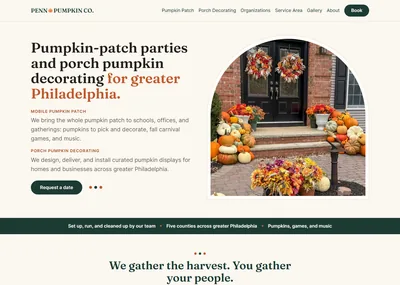
Penn Pumpkin Co. brings the pumpkin patch to you. The crew sets up pumpkins to pick and decorate, fall carnival games, and music at schools, daycares, offices, and private gatherings, then runs the party and cleans it all up. The second side of the business is porch pumpkin decorating: autumn displays designed, delivered, and installed at homes and businesses, then removed when the season ends.
The company serves five counties around Philadelphia: Bucks, Montgomery, Chester, Delaware, and Philadelphia itself.
The challenge
We kicked off in mid-July. Pumpkin season doesn’t wait, so the site had to be live, indexed, and taking bookings before fall arrived. That gave us about five weeks.
The site also had to solve three problems:
- Two products that look alike but aren’t. A pumpkin-patch party and a decorated porch share a pumpkin and almost nothing else. Different buyers, different prices, different booking steps.
- The person booking isn’t the person having fun. The photos show happy kids, but parties are booked by adults: a PTO president, a school business manager, an office planner. They have questions a parent never asks, and those questions decide whether they book.
- A big service area without thin pages. Local search matters for a business like this, but a pile of near-identical town pages with the name swapped out is one of the fastest ways to get a site penalized by Google.
How we planned it
Before writing a single page, we set rules for what would be allowed to publish.
Every town page has to earn its place. A town gets its own page only when we have facts that are true of that town and no other: real road mileage from the home base, which delivery band it falls in, and what’s specific about it. Towns we couldn’t say anything specific about are still covered, listed on their county page, and can graduate to their own page later. It takes longer than generating a page per town, and it keeps the location pages clear of the thin-content penalties that sink templated town pages.
Nothing gets invented. Every claim on the site traces back to something the owner confirmed: what’s included, how weather is handled, what paperwork is available, how fast inquiries get answered. If we didn’t have a confirmed answer, it didn’t go on the page.
What we built
The finished site has more than 60 pages:
- A clear path for each service. Parties and porch decorating each get their own overview, packages, and how-it-works pages, so nobody has to untangle one from the other.
- Pages for the people who actually book. Elementary schools, preschools and daycares, PTOs and parent groups, offices, churches, and senior living each have a page that speaks to that buyer.
- A procurement page for business managers. Insurance, record checks for the crew, purchase orders, Net 30 terms, W-9s, and certificates of insurance, all answered up front. For a school, those answers are often the difference between “let’s book” and “I’ll get back to you.”
- Service-area pages for individual towns and for each surrounding county, every one built on real local facts.
- Planning guides on fall porch styling, seasonal timing, DIY pumpkin displays, and hiring a porch decorator.
- Online booking. Parties book through an embedded scheduler, and porch decorating has its own request flow, because a porch display is a different kind of order.
- Spam protection on every form, so real inquiries don’t get buried.
Reviews that fit a busy owner
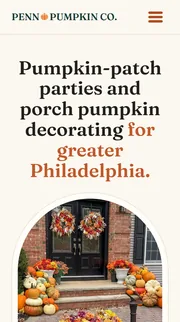
The owner reviewed the site the way he actually uses the web: on his phone. He recorded his screen while scrolling through the mobile site and talked through his notes as he went, and I worked straight from those recordings.
That feedback is all over the live site. The small labels that separate “Mobile pumpkin patch” from “Porch pumpkin decorating” on the homepage came from his note that the two services were blending together. A party headline that promised a festival “delivered to your door” became “A fall festival that comes to you,” because, as he pointed out, a pumpkin patch almost never ends up at a door.
The result
Penn Pumpkin Co. launched on August 17, about five weeks after kickoff, with the whole fall season still ahead of it. Parties book online, every organization type has a page written for it, and the location pages stand on real facts instead of filler.
Since launch, Penn Pumpkin Co. has booked more than $65,000 in revenue. Most of the company’s work happens in a single season, and the site was live and taking bookings before it started.
Want a site that works this hard for your business?
Tell me what you're working with. I'll come back with a clear plan and an honest recommendation.
Start a conversation